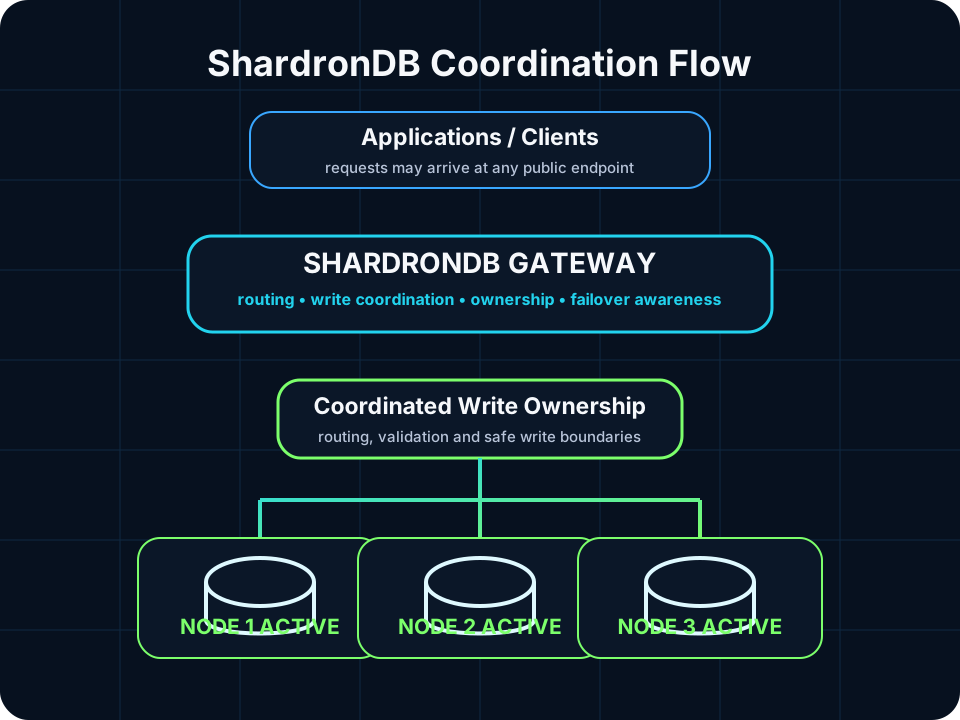
Active-active database definition
An active-active database architecture is a topology in which two or more database nodes, clusters or regions participate in normal service and remain capable of continuing some or all workload when another participant is unavailable.
The exact meaning depends on the write model. One system may call itself active-active because both sites serve reads while writes remain centralized. Another may allow writes in both regions. A sharded design may assign different tables, tenants or key ranges to different active owners. A distributed SQL database may coordinate transactions through a native consensus and storage layer.
For that reason, an architecture review should never stop at the label. It should document the read path, write path, data ownership model, replication direction, conflict behavior, consistency guarantee and failure mode.
Common active-active database models
Read-active, write-centralized
Multiple sites serve reads, but one designated primary or owner accepts writes. This reduces read latency and can simplify conflict control, although write failover is still required.
Multi-primary replication
More than one replica accepts writes and replicates changes to peers. The design must handle concurrent updates, uniqueness, ordering and certification or conflict resolution.
Sharded active ownership
Each node owns a defined subset of data or tables. Nodes are active because they serve their owned workload, while backup copies provide resilience.
Native distributed SQL
The database engine distributes storage, transactions and consensus internally. Applications see a logical database while the platform coordinates nodes.
Potential benefits
The most visible benefit is reduced dependency on a cold or mostly idle standby. More nodes may contribute to reads, writes, regional latency reduction or tenant distribution during normal operation. This can improve capacity utilization and may reduce the amount of paid infrastructure that produces little daily work.
- Lower failover delay: traffic may already be flowing through more than one active path.
- Better resource utilization: secondary nodes can contribute useful workload instead of waiting only for an incident.
- Regional service: users may connect to a closer site when the data and consistency model allow it.
- Maintenance flexibility: workload can sometimes be drained or redistributed before planned maintenance.
- Horizontal growth: ownership or partitioning can spread load beyond one server.
These are potential outcomes, not automatic guarantees. An active-active design that creates excessive coordination, replication or conflict overhead can cost more and perform worse than a well-designed active-passive system.
Core risks and tradeoffs
Write conflicts
Two nodes may update the same logical row before each sees the other change. The system needs deterministic prevention, certification, serialization or conflict resolution. “Last write wins” is simple but can silently discard business intent.
Identity and uniqueness
Auto-increment values generated independently on different nodes can collide. UUIDs, node-aware sequences, range allocation, timestamp-based identifiers or a coordinated identity service may be used. ShardronDB’s public Layer 1 position is stricter: normal client inserts must not provide primary key values; the coordination layer validates the request and generates the identity after the guard passes.
Network partitions
A site may remain healthy locally while losing communication with peers. The architecture must decide whether to stop writes, continue with reduced guarantees, require quorum or isolate ownership. This is a consistency and business-rule decision, not merely a networking issue.
Replication lag and stale reads
Asynchronous replication can expose old data. Synchronous coordination can reduce that risk but adds latency and may reduce availability during network degradation. The design should state which operations require read-your-writes, monotonic reads or strict serializability.
Operational complexity
More active components increase monitoring, deployment, schema migration, backup, failback and incident-response complexity. A topology is not production-ready until those procedures are automated and repeatedly tested.
Active-active compared with related terms
| Term | Primary meaning | Typical write behavior | Main question |
|---|---|---|---|
| Active-active | Multiple nodes or sites participate in normal service. | May be centralized, partitioned or multi-writer. | How is workload participation coordinated? |
| Active-passive | One active primary with one or more standby nodes. | Writes normally go to one primary. | How fast and safely can failover occur? |
| Multi-primary | Multiple replicas can accept writes. | Writes can occur on more than one replica. | How are concurrent changes and conflicts handled? |
| Sharding | Data is partitioned across nodes. | Each shard usually owns part of the data. | How are keys, routing and cross-shard work managed? |
| Distributed SQL | A database engine distributes storage and transactions natively. | Writes are coordinated by the platform. | Can the workload accept the platform’s latency and operational model? |
How to evaluate an active-active design
- Define business targets: RTO, RPO, maximum stale-read window, regional latency and maintenance requirements.
- Classify writes: identify records that can be independently owned, records that may conflict and invariants that must never be violated.
- Choose the ownership model: single writer, tenant owner, shard owner, table owner, region owner or true multi-writer.
- Define partition behavior: decide what happens when nodes cannot communicate.
- Design identity generation: prevent primary key, unique key and business-key collisions.
- Plan recovery: test backups, point-in-time recovery, node rebuild, failback and data reconciliation.
- Measure total cost: include servers, network, licenses, power, cooling, observability, engineering and incident complexity.
Where ShardronDB fits
ShardronDB is not presented as a universal replacement for MariaDB Galera Cluster, MySQL InnoDB Cluster, PostgreSQL replication, distributed SQL or sharding middleware. It explores a coordination layer above relational database nodes. The public concept focuses on gateway-controlled requests, node-local table ownership, backup-table placement, coordinated identity generation, monitoring and safer active participation.
The distinction is important: ShardronDB attempts to make the write path explicit before a request reaches a database node. That creates a place to reject unsafe client-supplied primary keys, determine ownership, coordinate routing and record consistency signals. The private runtime and replication implementation remain outside the public Layer 1 scope.
Continue with the database coordination layer guide, the ShardronDB architecture overview, or the active-active versus active-passive comparison.
Frequently asked questions
What is an active-active database?
An active-active database architecture uses more than one database node or site during normal operation. Depending on the design, multiple nodes may serve reads, writes, or distinct owned data ranges while remaining available when another node fails.
Is active-active the same as multi-primary replication?
No. Multi-primary replication describes a replication topology in which more than one replica can accept writes. Active-active is a broader operating model that can also include routing, ownership, conflict rules, failover behavior and application-level coordination.
Does active-active guarantee zero downtime?
No architecture guarantees zero downtime. Active-active can reduce failover dependency, but availability still depends on network design, quorum, routing, consistency behavior, software defects, operational procedures and tested recovery paths.
When is active-active a poor fit?
It can be a poor fit when the workload is small, write conflicts are difficult to control, cross-region latency is unacceptable, the team lacks distributed-systems expertise, or active-passive failover already meets business requirements at lower complexity.
What should be tested before production?
Test concurrent writes, duplicate identity generation, network partitions, replication lag, failover and failback, stale reads, backup restoration, node rejoin, schema changes, monitoring alerts and application retry behavior.