What database high availability means
Database high availability (HA) is the ability to keep a database-backed service accessible through server, storage, network, process and maintenance events. Availability is usually expressed as a service objective, but architecture teams also need to define the failure domains included in that objective.
A design that survives one database process crash may not survive a rack outage. A multi-zone cluster may not survive operator error or corrupted data. A multi-region topology may remain online while violating consistency requirements. High availability therefore has to be evaluated against concrete scenarios.
RTO, RPO and consistency targets
RTO
Recovery Time Objective: the maximum target time between a failure and restored service.
RPO
Recovery Point Objective: the maximum acceptable data loss, often measured in time or transactions.
Consistency
The guarantees applications require after normal writes, retries, failover and network partitions.
Failure domain
The component boundary the design is expected to survive: process, host, rack, zone, region or operator action.
These targets interact. Synchronous replication can reduce RPO but adds commit latency and may reduce availability during communication failures. Asynchronous replication can improve local write latency but may lose recently acknowledged transactions. The correct tradeoff depends on business invariants.
Core HA components
Redundant database nodes
Redundancy removes a single server as the only copy or execution path. The replicas must be placed in independent failure domains and monitored for actual readiness, not merely process health.
Replication
Physical replication copies storage-level changes; logical replication copies row-level or transaction-level changes. Synchronous and asynchronous modes provide different latency and durability tradeoffs. Replication topology should match the failover and write-ownership model.
Health detection and fencing
Health checks must distinguish a slow node from a failed node and a network partition from a local outage. Fencing prevents an old primary from continuing to accept writes after a new primary is promoted.
Traffic routing
Applications need a stable endpoint, proxy, router, service discovery layer or connection policy that sends traffic to the correct node. Connection pools must refresh after topology changes.
Observability
Monitor replication lag, commit latency, error rates, queue depth, disk capacity, lock waits, node membership, backup age, restore tests and data-consistency signals. Alerts should map to operator actions.
Backups and point-in-time recovery
HA replicas protect service continuity but may replicate logical corruption. Independent backups, retention and verified restoration protect against accidental deletion, bad deployments, ransomware and prolonged corruption.
Common database HA patterns
| Pattern | Strength | Main limitation |
|---|---|---|
| Primary + standby | Simple authoritative write path and familiar failover model. | Promotion delay and potentially underused standby capacity. |
| Primary + read replicas | Read scaling and reporting isolation. | Stale reads and write failover still centered on one primary. |
| Multi-primary cluster | Multiple writable members and reduced promotion dependency. | Conflict, certification and distributed transaction complexity. |
| Sharded owners + replicas | Horizontal scale with explicit data ownership. | Routing, rebalancing and cross-shard operations. |
| Distributed SQL | Native replication, transactions and placement across nodes. | Platform adoption, latency and operational model changes. |
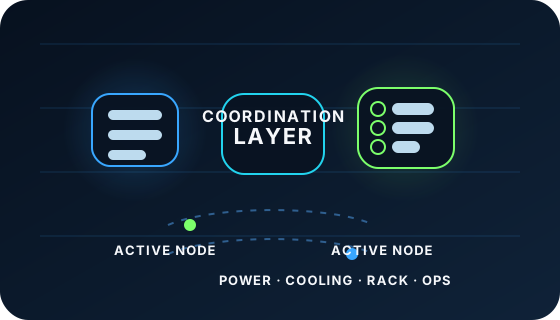
| Coordination layer | Central policy for validation, routing and node participation above relational nodes. | Additional critical control-plane and runtime responsibilities. |
Failure testing checklist
- terminate the active database process;
- disconnect one node from the network;
- simulate replication lag and disk exhaustion;
- restart or rebuild a failed node;
- promote and fail back without split-brain;
- verify application retry and idempotency behavior;
- restore a backup into an isolated environment;
- test schema changes while replicas are active;
- measure stale reads and lost acknowledged writes;
- reconcile data after a partial failure.
Runbooks should state who decides to fail over, what telemetry is required, how writes are fenced, how clients reconnect and how the old node is validated before rejoining.
HA and active-active architecture
Active-active is one possible HA strategy, but it should not be used as a synonym for availability. Multiple active nodes can reduce failover dependency and increase utilization, yet they also create more paths for conflicting writes or divergent state. Review the active-active database guide and the active-active versus active-passive comparison before selecting the model.
ShardronDB perspective
ShardronDB focuses on the control point before writes reach relational nodes. The public architecture discusses gateway validation, ownership-aware routing, generated primary keys, backup-table placement, monitoring and consistency checks. These mechanisms can contribute to HA, but they do not replace independent backups, network design, quorum decisions or recovery testing.
Use the architecture evaluation form to document your current model, node count and pain points without sending credentials or production data.
Frequently asked questions
What is database high availability?
Database high availability is the combination of architecture, replication, failover, monitoring and operational procedures used to keep database services accessible through component failures and planned maintenance.
Are backups part of high availability?
Yes, but backups solve a different failure class. Replicas can reproduce corruption or accidental deletes, while backups and point-in-time recovery provide an independent restoration path.
What is the difference between RTO and RPO?
RTO is the target time to restore service. RPO is the maximum acceptable amount of data loss measured in time or transactions.
Does replication alone provide high availability?
No. Replication must be combined with health detection, fencing, routing, failover, application retry behavior, monitoring and tested recovery procedures.