Definitions
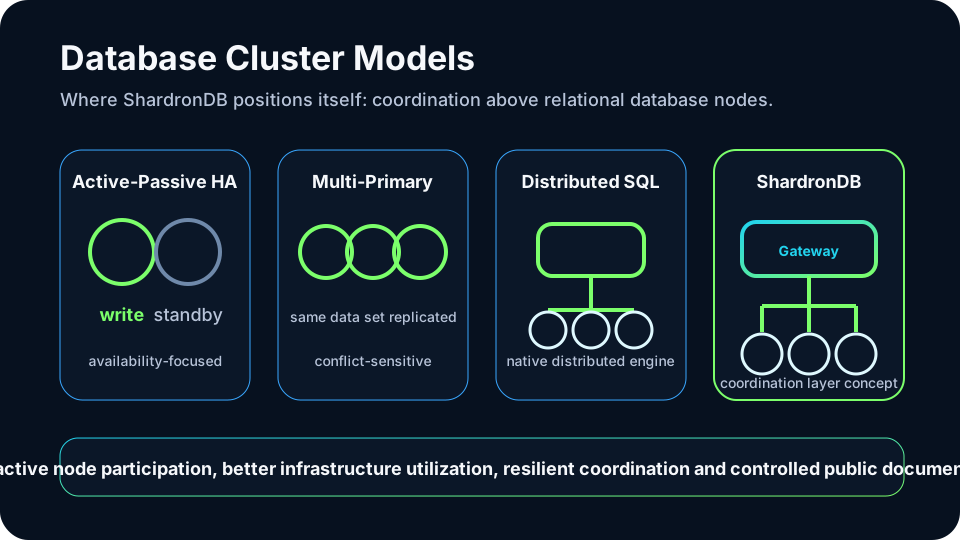
Active-passive: one node or site serves the authoritative workload while standby capacity is prepared to take over after a health check, election or operator action.
Active-active: two or more nodes or sites participate in normal service, potentially through reads, writes, partition ownership or regional routing.
The comparison is not binary in practice. A primary database with read replicas is active-passive for writes but active-active for reads. A sharded system can have multiple active owners while each shard still uses active-passive replication. A multi-region application may be active-active at the web tier but active-passive at the database tier.
Side-by-side comparison
| Criterion | Active-passive | Active-active |
|---|---|---|
| Normal write path | Usually one primary. | May be multi-writer or partitioned among owners. |
| Failover | Requires promotion, redirection or election. | May redirect to an already active participant. |
| Conflict risk | Lower because writes are centralized. | Higher when overlapping writes occur. |
| Capacity use | Standby may be idle or used for reads, reporting and backups. | More nodes can contribute to normal workload. |
| Consistency design | Typically easier to reason about. | Must define synchronization, ownership and partition behavior. |
| Operational complexity | Lower in many deployments. | Higher due to routing, reconciliation and distributed failure modes. |
| Cost profile | Potential underuse of reserved capacity. | Higher engineering and coordination cost, potentially better utilization. |
| Best fit | Workloads that prioritize simplicity and predictable writes. | Workloads requiring regional activity, write distribution or continuous capacity participation. |
RTO, RPO and failure behavior
Recovery Time Objective (RTO) describes how quickly service should return. Active-passive RTO includes detection, promotion and connection redirection. Active-active may shorten that sequence because another participant is already active, but a routing or quorum event may still be required.
Recovery Point Objective (RPO) describes acceptable data loss. Architecture labels do not determine RPO. A synchronous active-passive system can provide stronger durability than an asynchronous active-active system. Confirm exactly when a transaction is acknowledged and how many failure domains contain the committed data.
Network partitions are especially important. An active-passive system may fence the old primary before promoting a new one. An active-active system must decide which side can continue writing, whether ownership can be isolated, and how divergent changes will be reconciled.
Infrastructure utilization and cost
Standby nodes consume server, storage, power, cooling, rack, license, backup and monitoring resources. That does not make them unnecessary; they are insurance capacity. The economic question is whether that capacity can safely perform reads, analytics, backups or owned production work without weakening recovery.
Active-active can improve utilization, but it introduces coordination cost: extra network traffic, conflict detection, distributed tracing, specialized testing and more complex incident response. A complete ROI model should include both infrastructure and engineering costs. The ShardronDB ROI calculator is an awareness tool, not a guaranteed savings forecast.
When to choose each model
Active-passive is often appropriate when
- one authoritative write path is acceptable;
- the business can tolerate a tested failover interval;
- write conflicts would be expensive or dangerous;
- the team values operational simplicity;
- replicas can still provide read, reporting or backup value.
Active-active deserves evaluation when
- multiple regions or sites must remain operational;
- normal-day use of additional nodes is economically important;
- data can be partitioned into clear owners;
- write latency to one remote primary is unacceptable;
- the team can test and operate distributed failure modes.
Hybrid architectures
Many production systems combine both models. For example, three active shards may each have a passive replica. Two regions may serve active reads while only the owning region writes a given tenant. A distributed SQL cluster may be active across zones while using regional placement constraints. This is why the unit of analysis should be the specific data set and operation, not the whole platform label.
ShardronDB perspective
ShardronDB asks whether relational database nodes that are already funded can participate more productively without exposing the application to uncontrolled multi-writer behavior. Its public concept uses a gateway and coordination layer, node-local ownership, backup placement and identity guards. It therefore sits between a simple active-passive model and a fully native distributed database decision.
Continue with the active-active database guide, the high availability guide, or the coordination-layer model.
Frequently asked questions
Which is simpler: active-active or active-passive?
Active-passive is usually simpler because one primary write path is authoritative. Active-active adds routing, ownership, conflict, consistency and reconciliation decisions.
Which architecture has a lower RTO?
Active-active can reduce the promotion step because multiple paths are already active, but actual RTO depends on traffic routing, health detection, quorum and application behavior. A well-tested active-passive design can also fail over quickly.
Does active-passive waste infrastructure?
Standby capacity may be underused during normal operation, but it still delivers recovery value. Some systems also use replicas for reads, backups or reporting. The right comparison is total value versus total cost, not a blanket claim of waste.
Can active-active reduce RPO to zero?
Only if the replication and commit model guarantees that acknowledged writes survive the relevant failure. Asynchronous active-active designs can still lose or diverge data.