How primary key collisions happen
A primary key collision occurs when two rows attempt to use the same identifier in a scope where that value must be unique. Across nodes, local sequence state may be valid while the combined system state is not.
Example: Node A and Node B both generate integer ID 5001 during a network delay. Each insert succeeds locally. When replication or consolidation occurs, one change conflicts or the system contains two logically incompatible records.
Collisions also occur outside the primary key. Email addresses, order numbers, external references, invoice numbers and idempotency keys may require global uniqueness.
Common identity strategies
| Strategy | Strength | Tradeoff |
|---|---|---|
| UUID / UUIDv7 / ULID | Decentralized generation and very low collision probability. | Larger indexes; random variants can fragment B-trees; does not protect business duplicates. |
| Node-aware numeric ID | Embeds node or shard identity into a sortable numeric value. | Requires clock, node-ID and bit-allocation discipline. |
| Allocated numeric ranges | Preserves compact integers and avoids overlap. | Range management, exhaustion and reassignment complexity. |
| Sequence offsets | Simple for a fixed number of writers. | Harder to scale dynamically; configuration mistakes create collisions. |
| Central ID service | One authority can guarantee allocation policy. | Creates latency and availability requirements for the allocator. |
| Ownership-based local sequence | Safe when identifiers are unique only inside a tenant or shard composite key. | Consumers must carry the ownership component everywhere. |
The ShardronDB PK Guard rule
ShardronDB’s public architecture applies a strict boundary to normal client inserts:
Client INSERT request
        ↓
Read table metadata and identify the real primary key
        ↓
Does payload contain the PK column?
    Yes → reject: CLIENT_PK_NOT_ALLOWED
    No  → continue
        ↓
ShardronDB generates and coordinates identity
        ↓
Route write to the owning node
The rule uses metadata rather than assuming every table uses a column named id. A table may use customer_id, order_key or another primary key. The protection must inspect the actual schema.
This rule has two goals: prevent accidental or malicious bypass of the allocation policy, and keep the authority for distributed identity inside the trusted system boundary.
Trusted internal flows
Backup restoration, migration, replication apply and deterministic recovery often need to preserve existing identifiers. These operations should not weaken the public gateway rule. They should use separate trusted paths with explicit authorization, audit logging and source mapping.
- normal client/API insert: PK prohibited;
- internal replication apply: PK allowed only under trusted protocol;
- backup/recovery apply: original PK preserved with controlled validation;
- data migration: deterministic mapping and collision report required;
- test fixtures: isolated environment or trusted import path.
Primary keys are not the only invariant
A generated technical ID can be unique while the business operation is duplicated. Payment requests, order submissions and lead imports need idempotency keys or natural-key checks. Inventory and account limits may require transaction coordination across several rows.
Define uniqueness at three levels:
- technical identity: every stored row has a unique primary key;
- business identity: a real-world entity is not inserted twice;
- operation identity: retries do not repeat an effect.
Index and performance considerations
Identifier selection affects B-tree locality, index size, cache behavior and storage. Sequential integers are compact and insertion-friendly but need coordination across writers. Random UUIDs distribute generation but may fragment indexes. Time-ordered UUID variants and ULIDs improve locality while preserving distributed generation, although engine-specific benchmarking is still necessary.
Collision testing checklist
- issue concurrent inserts from every writable node;
- repeat requests with the same idempotency key;
- simulate allocator unavailability and clock skew;
- rejoin a node with stale sequence state;
- import a backup containing existing identifiers;
- change ownership or add a new shard;
- attempt client payloads containing the real PK under alternate field names;
- verify logging and error codes for rejected requests.
Related architecture topics
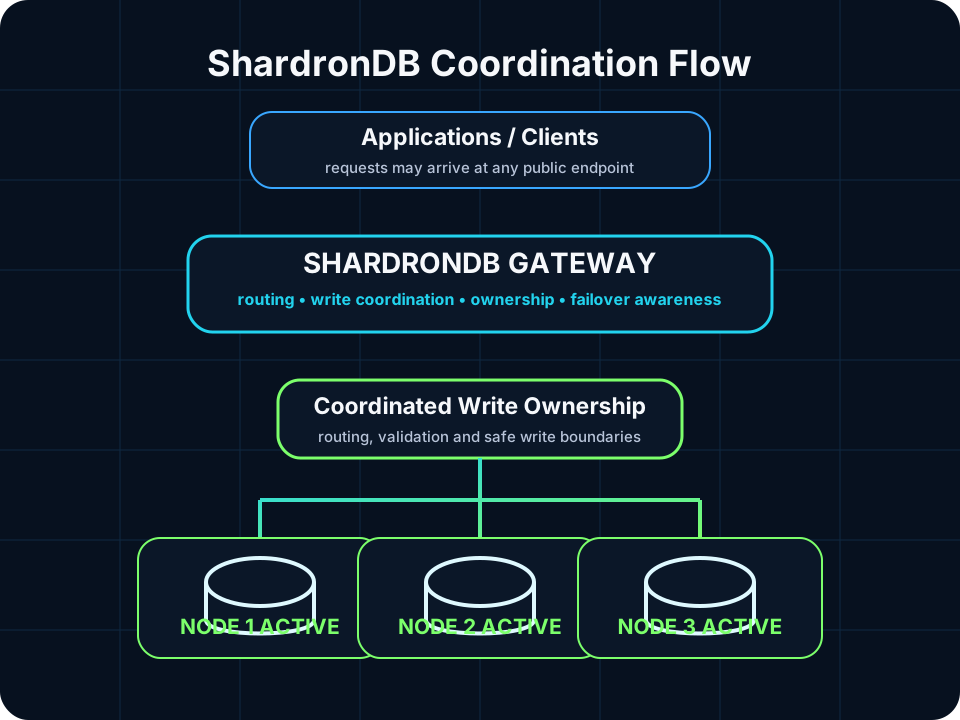
Identity design is closely connected to database sharding, multi-primary replication and gateway-controlled coordination. The ShardronDB Layer 1 architecture page explains how the guard fits into the public write path.
Frequently asked questions
What is a primary key collision?
A primary key collision occurs when two records attempt to use the same value for a primary key that must be unique. In distributed systems, independent generators can create the same value before nodes synchronize.
Do UUIDs eliminate all uniqueness problems?
UUIDs make collisions extremely unlikely when generated correctly, but they do not protect other unique business keys or prevent duplicate business operations.
Why reject client-supplied IDs?
Rejecting client-supplied primary keys keeps identity authority inside the database coordination system, reduces accidental collisions and prevents clients from bypassing allocation rules.
How are backup imports handled if IDs are rejected?
Trusted migration, replication, backup and recovery flows should use explicitly marked internal paths with deterministic mapping. They should not use the normal public insert endpoint.