Use cases and solution fit

Where can active-active database coordination create business value?

ShardronDB is best evaluated through workload, infrastructure cost, high-availability model and growth pressure—not only through isolated technical features.

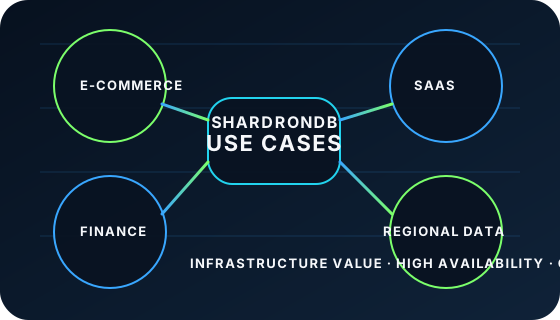
Use cases connect active-active thinking to real environments such as e-commerce, SaaS, finance, and regional data planning.

ShardronDB use case map linking active-active database coordination to e-commerce, SaaS, finance and regional data scenarios
Practical fit matters: the best candidates are usually multi-node environments with visible availability pressure and infrastructure cost.

Evaluation map

Look for environments where standby-heavy database capacity is visible.

The strongest candidates are systems where high availability is mandatory, write traffic matters, infrastructure cost is rising, and multiple relational nodes already exist or are being planned.

E-commerce

Order, inventory and customer activity growth

Useful when traffic spikes, campaign periods and continuous availability make passive-only standby resources expensive to justify.

  • High read/write variability
  • Need for continuity during campaigns
  • Growing database infrastructure spend
SaaS platforms

Tenant growth and regional scaling pressure

Multi-tenant platforms can evaluate whether tenant-aware routing and node ownership can improve capacity planning.

  • Tenant-based workload patterns
  • Planned multi-node growth
  • Operational visibility needs
Finance & operations

Continuity-first transaction systems

Systems with strict continuity expectations may benefit from reviewing active participation models while keeping sensitive internals private.

  • High availability requirements
  • Audit-aware architecture discussion
  • Controlled pilot scope
Regional data

Data locality and multi-site planning

Organizations with multiple data centers or regional nodes can evaluate active usage, backup placement and operational cost more explicitly.

  • Regional infrastructure
  • Data placement strategy
  • Disaster readiness planning
Infrastructure optimization

Power, cooling, rack and server ROI

Infrastructure teams can estimate the difference between paid capacity and productive database capacity.

  • Standby server cost visibility
  • Rack and cooling pressure
  • Budget justification needs
Pilot program

Controlled private evaluation

Begin with a non-sensitive architecture review, then define a limited proof-of-concept scope if the fit is credible.

  • No production dumps required
  • No secrets in public forms
  • Layered evaluation path

Fit signals

Good signs that ShardronDB is worth evaluating.

You already operate multiple database nodes.But only part of that capacity carries the normal production workload.
Standby cost is becoming visible.Hardware, cloud instances, backup storage, power, cooling or rack planning affect budget decisions.
You want to preserve relational database investments.The goal is not necessarily to replace the database platform immediately.
You need an architecture-first conversation.Before runtime internals, you want to know whether the model fits your use case.

Not a fit for every situation

  • If one simple database server is enough and cost is not an issue.
  • If the team prefers a full native distributed SQL migration immediately.
  • If the workload cannot be meaningfully partitioned or coordinated.
  • If public forms would require sharing secrets or production data.

Next step

Turn a use case into an evaluation request.

Share only non-sensitive architecture information. The first step is to understand the current HA model, node count, workload pressure and infrastructure cost drivers.