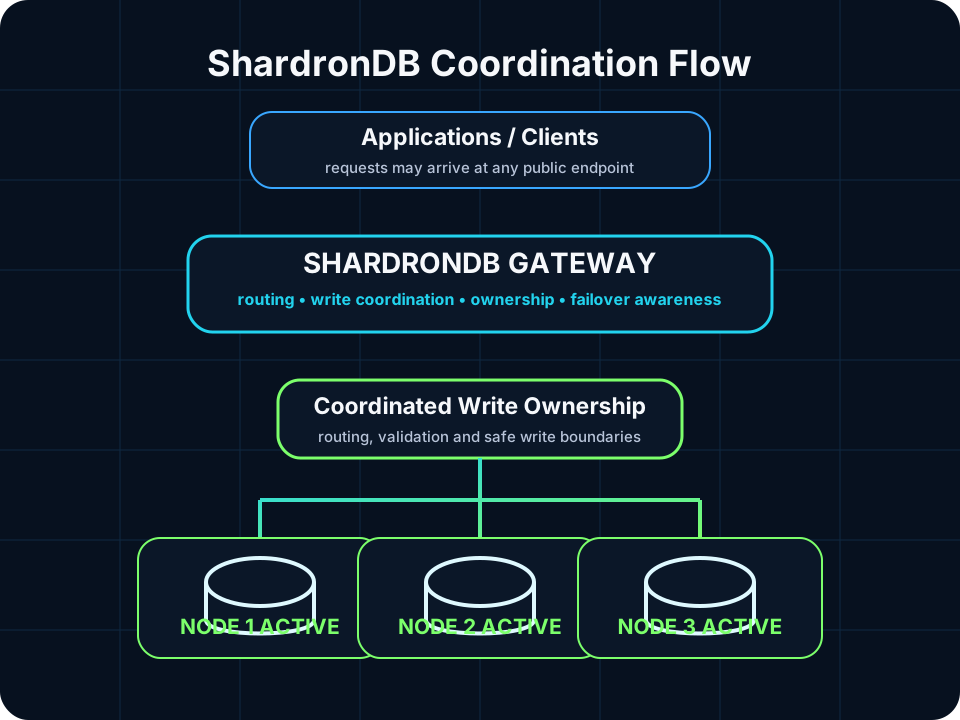
Coordination layer definition
A database coordination layer is middleware that applies topology-aware policy before or around database operations. It may combine functions normally spread across application code, connection proxies, identity services, sharding routers and operational control planes.
The term should not imply that every transaction is globally serialized. Coordination can be selective. Independent data owners may process local writes, while only identity allocation, ownership transitions or cross-node invariants require stronger coordination.
Possible responsibilities
Request validation
Reject malformed, unauthorized or unsafe requests before they reach a database node.
Ownership-aware routing
Map a table, tenant, key range or workload to its active owner and backup placement.
Identity coordination
Generate or allocate primary keys and prevent client bypass of identity rules.
Health and consistency signals
Use node status, replication state and consistency checks to make routing decisions observable.
Other responsibilities may include retry policy, idempotency, schema metadata, topology versioning, write journaling, audit records and controlled maintenance modes. The scope should be deliberately limited; an overgrown gateway becomes difficult to test and scale.
Illustrative write path
Client / application
        ↓
Authenticate and validate request
        ↓
Resolve schema metadata and ownership
        ↓
Apply PK Guard and idempotency policy
        ↓
Generate or reserve identity
        ↓
Route to active owner
        ↓
Coordinate backup / replication behavior
        ↓
Record result, latency and consistency state
Every stage needs a defined failure response. For example, if ownership metadata is unavailable, the safest choice may be to stop the write rather than guess. If identity has been reserved but the database write fails, the retry must remain idempotent.
Control plane and data plane
A production design should distinguish the control plane, which manages topology, ownership and policy, from the data plane, which processes live requests. Gateways can often remain stateless by reading versioned control data from a durable store. Changes to ownership should be atomic, auditable and reversible.
Redundant gateway instances are necessary so the coordination layer does not become a single point of failure. They must agree on the topology version used for a write and reject stale ownership information when safety requires it.
Benefits and tradeoffs
| Potential benefit | Associated responsibility |
|---|---|
| Consistent request policy across applications. | Gateway availability, latency and version management. |
| Central ownership and routing visibility. | Accurate metadata and safe ownership transitions. |
| Primary key and idempotency control. | Durable allocation and retry semantics. |
| More controlled active node participation. | Node health, replication and consistency awareness. |
| Database-engine flexibility. | Lowest-common-denominator behavior and engine-specific adapters. |
Coordination layer compared with alternatives
Database proxy
A proxy commonly handles connection routing, read/write splitting or failover. A coordination layer may operate at a richer request and ownership level. Some products can perform both roles.
Sharding middleware
Sharding middleware focuses on partition rules and query routing. A coordination layer may include sharding but also identity, backup placement and write guards.
Multi-primary cluster
A multi-primary cluster coordinates replication among writable copies. A coordination layer can instead reduce overlapping writes by routing each data domain to an owner.
Distributed SQL
Distributed SQL integrates consensus, transactions, replication and storage into the database engine. A layer above existing relational nodes cannot automatically reproduce every native guarantee.
The ShardronDB public model
ShardronDB presents the following Layer 1 ideas:
- gateway-controlled request routing;
- node-local table ownership;
- backup-table placement across nodes;
- write coordination and consistency checks;
- primary key collision prevention;
- monitoring of multi-node participation;
- separation of public client flows from trusted internal replication or recovery flows.
The public site intentionally does not publish runtime source code, replication engine internals, production deployment scripts or private operational logic. The purpose of Layer 1 is to make the architecture reviewable without exposing the protected implementation.
Evaluation questions
- Can data ownership be defined without ambiguity?
- Which operations need global coordination?
- What happens when the gateway cannot reach control state?
- How are duplicate requests and partial failures handled?
- How is the gateway scaled, upgraded and monitored?
- Which guarantees come from the database engine and which come from the layer?
- How are backups restored and nodes reconciled?
- What evidence will demonstrate correctness and performance?
Use the architecture evaluation form to structure these questions, or read the current public architecture page.
Frequently asked questions
What is a database coordination layer?
A database coordination layer is a control and routing component between applications and database nodes. It can validate requests, select an owner, coordinate identity, apply write policy and expose topology health.
Is a coordination layer the same as a database proxy?
A proxy mainly routes connections or queries. A coordination layer may also understand ownership, request semantics, write safety, identity generation, replication state and consistency policy.
Does a coordination layer become a single point of failure?
It can if deployed as one instance. Production design requires redundant stateless gateways or replicated control state, health checks and a tested failure path.
Can it replace a distributed SQL database?
Not universally. Distributed SQL integrates storage, transactions and consensus inside the database engine. A coordination layer works above existing relational nodes and has different capabilities and limitations.