Server investment value
The goal is to turn more database nodes into useful capacity, not only insurance capacity.
ShardronDB · Active-active database architecture
ShardronDB is a Layer 1 active-active database coordination concept. It starts from a practical question: if you already pay for multiple database servers, power, cooling, rack space and operations, can more of that capacity participate in the normal workload instead of waiting passively for failure?
Turkish/local positioning: AktifDb — Aktif-Aktif Veritabanı Koordinasyon Katmanı.
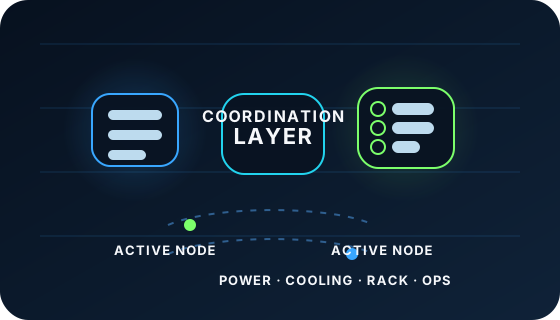
ShardronDB starts with infrastructure value, continuity and operational efficiency, then connects those goals to ownership, routing, consistency, identity safety and recovery design.
Use the database knowledge hub to compare active-active, active-passive, sharding, multi-primary replication, high availability and coordination-layer approaches before evaluating the project.
Share your current HA, replication or cluster model and request a use-case review.
02Estimate how much standby-heavy database infrastructure may be costing you monthly.
03See where active-active coordination may matter: e-commerce, SaaS, finance and regional data.
The hidden cost of passive capacity
Active-passive designs protect continuity, but they often reserve server capacity for failure scenarios. That reservation can be expensive: hardware is purchased, powered, cooled, patched and monitored even when it contributes limited productive work during normal operation.
The goal is to turn more database nodes into useful capacity, not only insurance capacity.
Database architecture affects electricity, cooling, rack density and data-center planning.
When nodes are useful every day, monitoring, maintenance and capacity planning become easier to justify.
Redundancy remains important, but the architecture can also aim for productive workload participation.
Before ShardronDB
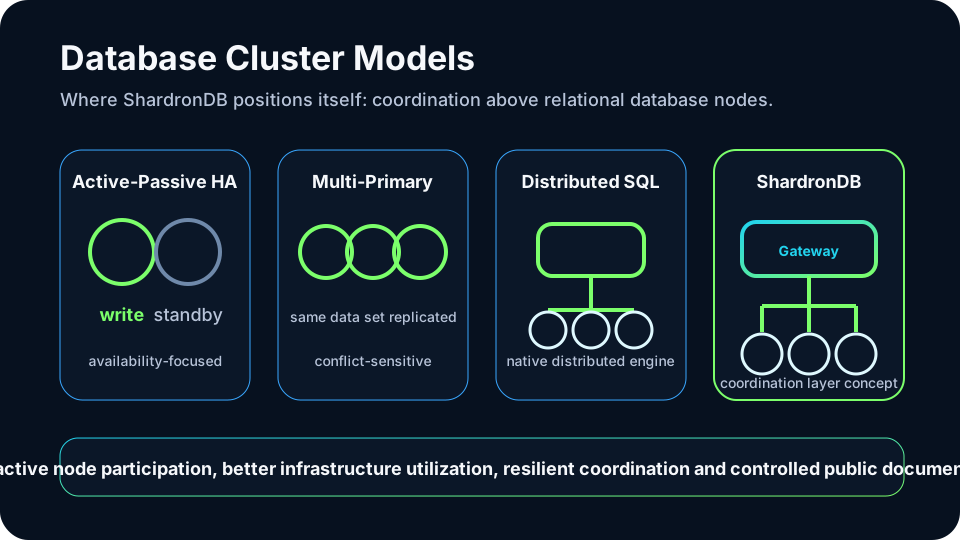
Each model is valid in the right context. ShardronDB does not claim to replace every database or cluster product. It positions itself as a coordination-layer concept for teams that want to examine active participation across relational database nodes.
One database server is easy to reason about, but growth eventually creates pressure around CPU, storage, availability and maintenance windows.
A standby node increases availability but may remain underused until failover, while still requiring power, cooling, monitoring and patching.
Multiple writable copies can be powerful, but consistency, conflict behavior and full-copy replication must be understood carefully.
Sharding divides data and workload, but raises questions around ownership, routing, backups, resharding and operational visibility.
A strong option when platform change is acceptable, but adoption can mean migration, retraining and new operational habits.
Explores how gateway-driven routing, ownership and backup placement can help relational nodes participate more actively.
The ShardronDB value proposition
ShardronDB focuses on the architecture between the application and relational database nodes. The public Layer 1 story explains why active-active coordination matters, what kinds of infrastructure waste it tries to reduce, and how the concept differs from standby-heavy HA patterns.
Operational advantages
The business case and the technical case must support each other. Infrastructure owners need cost and continuity context, while architects need explicit ownership, identity, routing, consistency and recovery boundaries.
Standby capacity is valuable for recovery, but a coordination model can explore ways to make more nodes contribute before a failure happens.
When existing database servers do more useful work, the organization can extract more value from capital expenditure and hosting spend.
Database topology impacts energy, thermal load, rack density, monitoring overhead and data-center capacity strategy.
Architecture teams need use cases, cost framing and risk analysis before they invest attention in technical internals.
Trust-building path
For CTOs, DBAs and system architects, trust comes from progressive disclosure: first the value model, then architecture, then use-case review, then controlled technical discussion.
Comparison
This table is a positioning comparison, not a benchmark claim. It helps a visitor understand where ShardronDB fits before reading deeper technical pages.
| Criterion | Active-passive HA | Multi-primary cluster | Native distributed SQL | ShardronDB concept |
|---|---|---|---|---|
| Primary value | Availability through failover. | Multiple nodes can accept writes. | Distributed engine built into the database. | Coordination layer for more active use of relational nodes. |
| Normal capacity use | Some nodes may wait passively. | Nodes are active, but full-copy replication can increase overhead. | Managed by native distributed architecture. | Aims to reduce idle capacity through planned active participation. |
| Cost lens | Standby hardware still has power, cooling, rack and maintenance cost. | Operational complexity and conflict handling can become costly. | Adoption may require migration and skill investment. | Focuses on extracting more value from existing relational-node investments. |
| Adoption path | Familiar and common. | Requires careful write and conflict design. | Often a larger platform decision. | Presented first as a layered architecture concept and evaluation path. |
| Best next question | How fast and reliable is failover? | How are conflicts and consistency managed? | Can the team adopt a new distributed database platform? | Which current nodes, workloads and costs could be reorganized? |
Technical curiosity
Technical readers can continue through the database topic cluster, public architecture, official references, use cases or a controlled evaluation request.
Next step
Start with a use-case review or ROI awareness estimate. Then continue into Layer 1 architecture details when the business value is clear.